Browse · MathNet
PrintAustria 2010
Austria 2010 geometry
Problem
A diagonal in a hexagon is considered a "long" diagonal, if it divides the hexagon into two quadrilaterals. Any two long diagonals divide the hexagon into two triangles and two quadrilaterals. We are given a convex hexagon with the property that the division into pieces by any two long diagonals always yields two isosceles triangles with sides of the hexagon as bases. Show that such a hexagon must have a circumcircle.
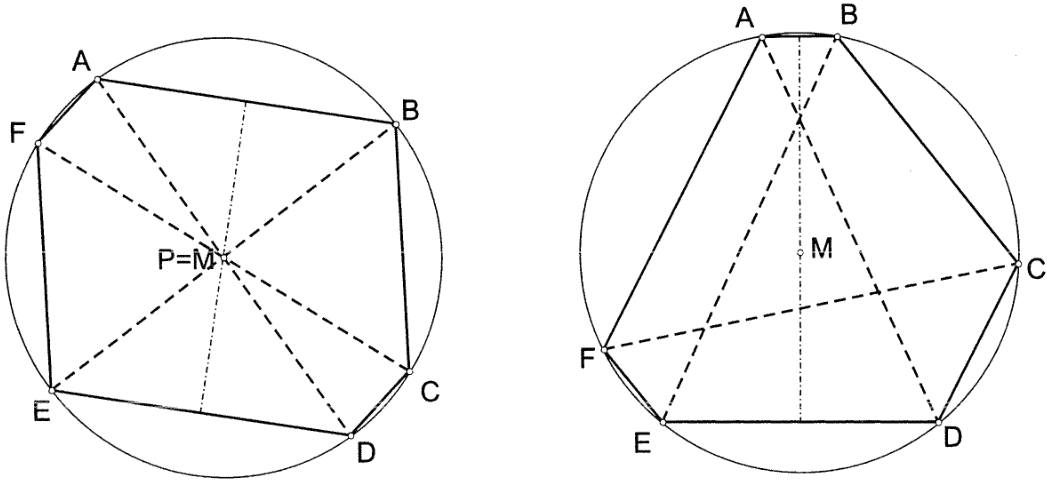
Solution
Since any two opposing isosceles triangles (such as ABP and DEP) have a common angle at their vertices, they must be similar, and their bases therefore parallel. The angle bisector in their common vertex is therefore also the common altitude. If all three diagonals of the hexagon , this point is also a common point of all angle bisectors. It must therefore be the same distance from and , as it lies on the bisector of , but the same holds for and , and , and so on. This point is therefore equidistant from all corners of the hexagon, and is therefore the mid-point of the circumcircle of the hexagon. If the diagonals of the hexagon do not have a common point, they form a triangle. The angle bisectors have a common point, namely the incenter of this triangle, which we again call M. The same holds for this point M as in the previous situation, and we once again have established the existence of a circumcircle of the hexagon, as claimed.
Techniques
Triangle centers: centroid, incenter, circumcenter, orthocenter, Euler line, nine-point circleAngle chasingConstructions and loci