Browse · MathNet
PrintRomanian Master of Mathematics
Romania geometry
Problem
A lattice point in the Cartesian plane is a point whose coordinates are both integral. A lattice polygon is a polygon whose vertices are lattice points. Let be a convex lattice polygon. Prove that is contained in a convex lattice polygon exactly one vertex of which is not a vertex of , and the vertices of all lie on the boundary of .
Solution
Let be the extra vertex of a desired polygon ; then is the convex hull of and . Thus, a point fits the bill if and only if this convex hull contains no vertices of in its interior.
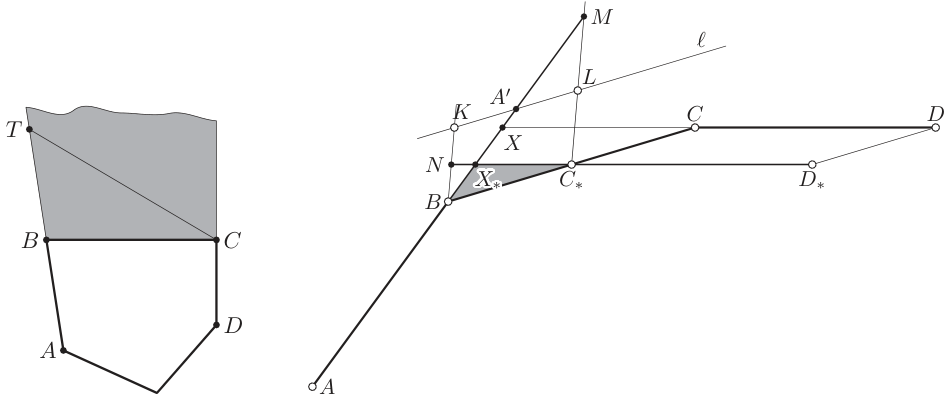
Each segment joining two lattice points is partitioned by lattice points into congruent elementary segments. Define the elementary length of to be the length of any of those elementary segments. Take any three consecutive sides , , and on the boundary of . Consider the convex region bounded by the segment and the rays complementary to the rays and (including the boundary). If this region is unbounded (see the left figure below), then it contains some lattice point (e.g., the point with ), and any such point satisfies the problem requirements. Thus, in what follows we assume that the two rays cross each other at some point . Assume further that the triangle contains no lattice points outside the segment , as any other such point would satisfy the requirements.
Let be a lattice point on the segment such that , let be the point on such that , and let be the point such that (see the right figure below). Then the triangle contains no lattice points apart from and . Consider the half-plane determined by the line and containing no interior points of . Let be the line in that half-plane parallel to , containing some lattice points, and nearest to among such. Let the ray meet at a point which belongs to the elementary segment on (we assume that ; the point may coincide with but not with ). Then the ray crosses the ray (excluding ), otherwise lies in the triangle . The only lattice points contained in the parallelogram are its vertices. This yields that there are no lattice points strictly inside the strip defined by the parallel lines and .
Let and be the meeting points of the rays and , respectively. Then the segments and contain no lattice points except their endpoints, so and . Therefore, Choose now to be a side of largest elementary length. Then which contradicts the triangle inequality.
REMARKS. (1) The usage of elementary length seems to be crucial. In particular, under the assumption that the triangle contains no lattice points outside , an inequality similar to () does not necessarily hold. (2) Any lattice parallelogram of unit area may be transformed into a unit square by an affine transform preserving the set of lattice points. If one applies such a transform to the parallelogram , inequality () may become more transparent.
---
Alternative solution.
We use the same notions of elementary segments and elementary lengths as in Solution 1. We say that a segment is sloped if it is neither horizontal nor vertical. If has no sloped sides, then is a rectangle, and the problem statement is trivial: one may choose any lattice point on the extension of any side. So, in what follows, we assume that has a sloped side.
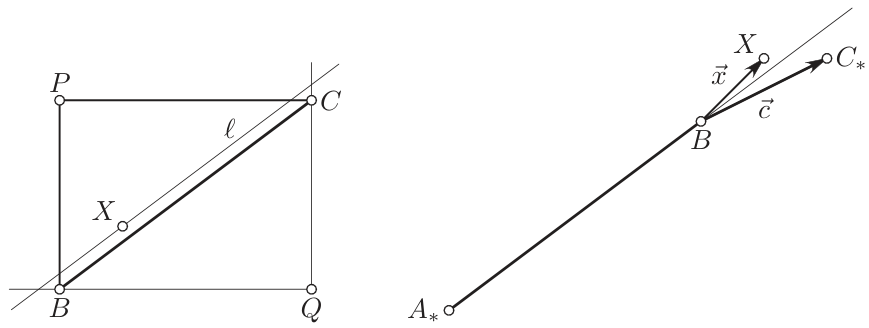
Lemma 1. Let be a sloped segment of the boundary of with no lattice points in its interior, and let be a lattice point such that the segments and are not sloped, and the triangle lies outside . Then there exists a unique lattice point in the triangle such that the area of the triangle is . Proof. Choose a lattice point such that is a rectangle. As in Solution 1, let denote the line through some lattice point parallel to , lying outside , and nearest to the line under these constraints (see the left figure below). The line crosses the interior of the angle along an interval of length , so this interval should contain a lattice point . The triangle contains no lattice points apart from the vertices, so its area is due to Pick's formula. Moreover, any such point should lie within the angle , and crosses this angle along a segment of length . Hence is the required unique lattice point.
Denote the point defined in Lemma 1 by .
Lemma 2. Let and be two consecutive sides on the boundary of , and let and be elementary segments on the sides and , respectively. Assume that both coordinates of are positive, and that the line strictly separates the points and . Then both coordinates of the vector are also positive, and . Proof. Since separates and , the vector is a linear combination of and with positive coefficients; so the coordinates of are positive. Since the area of the triangle equals , the vectors and span the whole lattice, so the coefficients of the linear combination are integers. Finally, the angle between and is acute, so , as desired.
Now, choose a sloped side of of a maximal elementary length, and let be the corresponding part of the boundary of . Let and be the points on the segment such that . Let and . Then, due to Lemma 2, the line does not separate and , and the line does not separate and . Therefore, the segment lies in the same angle of the lines and as , so may serve as a suitable vertex of .
Each segment joining two lattice points is partitioned by lattice points into congruent elementary segments. Define the elementary length of to be the length of any of those elementary segments. Take any three consecutive sides , , and on the boundary of . Consider the convex region bounded by the segment and the rays complementary to the rays and (including the boundary). If this region is unbounded (see the left figure below), then it contains some lattice point (e.g., the point with ), and any such point satisfies the problem requirements. Thus, in what follows we assume that the two rays cross each other at some point . Assume further that the triangle contains no lattice points outside the segment , as any other such point would satisfy the requirements.
Let be a lattice point on the segment such that , let be the point on such that , and let be the point such that (see the right figure below). Then the triangle contains no lattice points apart from and . Consider the half-plane determined by the line and containing no interior points of . Let be the line in that half-plane parallel to , containing some lattice points, and nearest to among such. Let the ray meet at a point which belongs to the elementary segment on (we assume that ; the point may coincide with but not with ). Then the ray crosses the ray (excluding ), otherwise lies in the triangle . The only lattice points contained in the parallelogram are its vertices. This yields that there are no lattice points strictly inside the strip defined by the parallel lines and .
Let and be the meeting points of the rays and , respectively. Then the segments and contain no lattice points except their endpoints, so and . Therefore, Choose now to be a side of largest elementary length. Then which contradicts the triangle inequality.
REMARKS. (1) The usage of elementary length seems to be crucial. In particular, under the assumption that the triangle contains no lattice points outside , an inequality similar to () does not necessarily hold. (2) Any lattice parallelogram of unit area may be transformed into a unit square by an affine transform preserving the set of lattice points. If one applies such a transform to the parallelogram , inequality () may become more transparent.
---
Alternative solution.
We use the same notions of elementary segments and elementary lengths as in Solution 1. We say that a segment is sloped if it is neither horizontal nor vertical. If has no sloped sides, then is a rectangle, and the problem statement is trivial: one may choose any lattice point on the extension of any side. So, in what follows, we assume that has a sloped side.
Lemma 1. Let be a sloped segment of the boundary of with no lattice points in its interior, and let be a lattice point such that the segments and are not sloped, and the triangle lies outside . Then there exists a unique lattice point in the triangle such that the area of the triangle is . Proof. Choose a lattice point such that is a rectangle. As in Solution 1, let denote the line through some lattice point parallel to , lying outside , and nearest to the line under these constraints (see the left figure below). The line crosses the interior of the angle along an interval of length , so this interval should contain a lattice point . The triangle contains no lattice points apart from the vertices, so its area is due to Pick's formula. Moreover, any such point should lie within the angle , and crosses this angle along a segment of length . Hence is the required unique lattice point.
Denote the point defined in Lemma 1 by .
Lemma 2. Let and be two consecutive sides on the boundary of , and let and be elementary segments on the sides and , respectively. Assume that both coordinates of are positive, and that the line strictly separates the points and . Then both coordinates of the vector are also positive, and . Proof. Since separates and , the vector is a linear combination of and with positive coefficients; so the coordinates of are positive. Since the area of the triangle equals , the vectors and span the whole lattice, so the coefficients of the linear combination are integers. Finally, the angle between and is acute, so , as desired.
Now, choose a sloped side of of a maximal elementary length, and let be the corresponding part of the boundary of . Let and be the points on the segment such that . Let and . Then, due to Lemma 2, the line does not separate and , and the line does not separate and . Therefore, the segment lies in the same angle of the lines and as , so may serve as a suitable vertex of .
Techniques
Convex hullsPick's theoremVectors