Browse · MathNet
PrintFinal Round of National Olympiad
Estonia geometry
Problem
For which natural numbers is it possible to cut a regular -gon into smaller pieces with regular polygonal shape? (The pieces may have different number of sides.)
Solution
Answer: 3, 4, 6, 12.
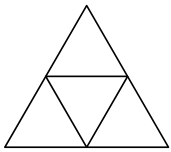
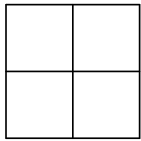
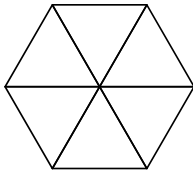
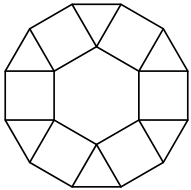
A regular triangle can be partitioned into four regular triangles of equal size (Fig. 23), a regular quadrilateral can be partitioned into four regular quadrilaterals with equal size (Fig. 24) and a regular hexagon can be partitioned into six regular triangles of equal size (Fig. 25). By building alternately equilateral triangles and squares onto the sides of a regular 12-gon, just a regular hexagon remains (Fig. 26), whence also a regular 12-gon can be partitioned in the required way.
Show now that other regular polygons cannot be partitioned into smaller regular polygons. For that, consider an arbitrary polygon that is partitioned into regular polygons. As the size of an internal angle of a regular polygon is less than and not less than , at most two regular polygons can meet at each vertex.
If a vertex of the big -gon is filled by just one smaller polygon then this piece is an -gon itself. Beside it, there must be space for at least one regular polygon. No more than two regular polygons can be placed there since the sum of the internal angles of these polygons and the -gon itself would exceed . Two new pieces can be placed only if all these three pieces are triangular, which gives . It remains to study the case where there is exactly one polygon beside the -gonal piece. The size of the internal angle of the -gon being at most implies . The case is impossible as its external angles are of size but no regular polygon has internal angles of size strictly between and .
If each vertex of the big -gon is the meetpoint of two smaller regular polygons then one of them must be a triangle since other regular polygons have internal angles of size or more. Beside a triangle, there is space for a triangle, a quadrilateral or a pentagon.
Figure 23 Figure 24 Figure 25 Figure 26
Figure 27
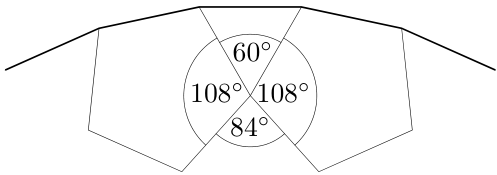
In the first two cases, the size of the internal angles of the -gon will be and , respectively, covering the cases and . It remains to show that the third case with a triangle and a pentagon meeting at each vertex is impossible. Indeed, the side length of the pentagon must coincide with the side length of the initial big -gon, because it is impossible to place a regular polygon beside the pentagon along one side. For the same reason, another pentagon must be built to the second next side along the boundary of the initial polygon. These two pentagons meet at the third vertex of the triangle built to the side between (Fig. 27). But the ulterior angle between the sides of the pentagons at the meeting point has size , which cannot be filled with interior angles of regular polygons.
A regular triangle can be partitioned into four regular triangles of equal size (Fig. 23), a regular quadrilateral can be partitioned into four regular quadrilaterals with equal size (Fig. 24) and a regular hexagon can be partitioned into six regular triangles of equal size (Fig. 25). By building alternately equilateral triangles and squares onto the sides of a regular 12-gon, just a regular hexagon remains (Fig. 26), whence also a regular 12-gon can be partitioned in the required way.
Show now that other regular polygons cannot be partitioned into smaller regular polygons. For that, consider an arbitrary polygon that is partitioned into regular polygons. As the size of an internal angle of a regular polygon is less than and not less than , at most two regular polygons can meet at each vertex.
If a vertex of the big -gon is filled by just one smaller polygon then this piece is an -gon itself. Beside it, there must be space for at least one regular polygon. No more than two regular polygons can be placed there since the sum of the internal angles of these polygons and the -gon itself would exceed . Two new pieces can be placed only if all these three pieces are triangular, which gives . It remains to study the case where there is exactly one polygon beside the -gonal piece. The size of the internal angle of the -gon being at most implies . The case is impossible as its external angles are of size but no regular polygon has internal angles of size strictly between and .
If each vertex of the big -gon is the meetpoint of two smaller regular polygons then one of them must be a triangle since other regular polygons have internal angles of size or more. Beside a triangle, there is space for a triangle, a quadrilateral or a pentagon.
Figure 23 Figure 24 Figure 25 Figure 26
Figure 27
In the first two cases, the size of the internal angles of the -gon will be and , respectively, covering the cases and . It remains to show that the third case with a triangle and a pentagon meeting at each vertex is impossible. Indeed, the side length of the pentagon must coincide with the side length of the initial big -gon, because it is impossible to place a regular polygon beside the pentagon along one side. For the same reason, another pentagon must be built to the second next side along the boundary of the initial polygon. These two pentagons meet at the third vertex of the triangle built to the side between (Fig. 27). But the ulterior angle between the sides of the pentagons at the meeting point has size , which cannot be filled with interior angles of regular polygons.
Final answer
3, 4, 6, 12
Techniques
Angle chasingConstructions and loci