Browse · MathNet
PrintSelected Problems from Open Contests
Estonia geometry
Problem
A square lies in the coordinate plane with its vertices and lying on different coordinate axes. Prove that one of the vertices or lies on the line and the other one on .
Solution
Assume without loss of generality that is located on the -axis and is located on the -axis, let these points have coordinates of and . As the diagonals of a square bisect each other, we know that the intersection point of diagonal is also the mid-point of , i.e. and .
As the diagonals of a square are perpendicular to each other and of the same length, the vectors and have the same length as the vector and are perpendicular to it. But for a given vector , there are exactly two vectors perpendicular to and having the same length as it: and . For the vector we get and w.l.o.g. we can assume that and . Now from here and . Thus, we see that the point is located on the line and point is located on the line .
---
Alternative solution.
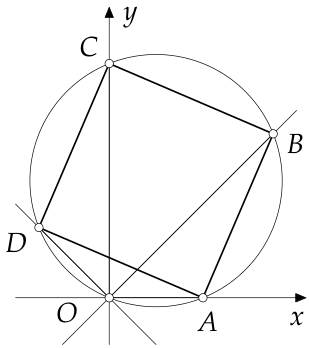
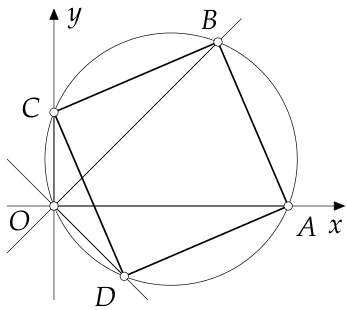
W.l.o.g., assume that the vertices of the square are labelled counter-clockwise with , , where (other cases are similar). Let be the origin, then , i.e. the circumcircle (with diameter ) of the square passes through the origin . Based on the assumptions made, definitely lies in the first quadrant and has to lie in the second quadrant (Fig. 4) or in the fourth quadrant (Fig. 5), otherwise the circle with the diameter cannot pass the origin.
Fig. 4
Fig. 5
diameter AC) of the square ABCD passes through the origin O. Now note that the vertices of the square divide its circumcircle into four equal arcs of , each having an inscribed angle of subtending on it. Thus, , i.e., lies on the line with equation (if or , then one of those angles will lose its meaning, however, the other one is still and that is sufficient). Similarly, , if lies in the second quadrant, or , if lies in the fourth quadrant. In both cases, lies on the line ; this condition is also met in the special case .
As the diagonals of a square are perpendicular to each other and of the same length, the vectors and have the same length as the vector and are perpendicular to it. But for a given vector , there are exactly two vectors perpendicular to and having the same length as it: and . For the vector we get and w.l.o.g. we can assume that and . Now from here and . Thus, we see that the point is located on the line and point is located on the line .
---
Alternative solution.
W.l.o.g., assume that the vertices of the square are labelled counter-clockwise with , , where (other cases are similar). Let be the origin, then , i.e. the circumcircle (with diameter ) of the square passes through the origin . Based on the assumptions made, definitely lies in the first quadrant and has to lie in the second quadrant (Fig. 4) or in the fourth quadrant (Fig. 5), otherwise the circle with the diameter cannot pass the origin.
Fig. 4
Fig. 5
diameter AC) of the square ABCD passes through the origin O. Now note that the vertices of the square divide its circumcircle into four equal arcs of , each having an inscribed angle of subtending on it. Thus, , i.e., lies on the line with equation (if or , then one of those angles will lose its meaning, however, the other one is still and that is sufficient). Similarly, , if lies in the second quadrant, or , if lies in the fourth quadrant. In both cases, lies on the line ; this condition is also met in the special case .
Techniques
Cyclic quadrilateralsQuadrilaterals with perpendicular diagonalsCartesian coordinatesVectorsAngle chasing