Browse · MathNet
PrintIMO 2016 Shortlisted Problems
2016 geometry
Problem
Let be a triangle with circumcircle and incentre . Let be the midpoint of side . Denote by the foot of perpendicular from to side . The line through perpendicular to meets sides and at and respectively. Suppose the circumcircle of triangle intersects at a point other than . Prove that lines and meet on .
Solution
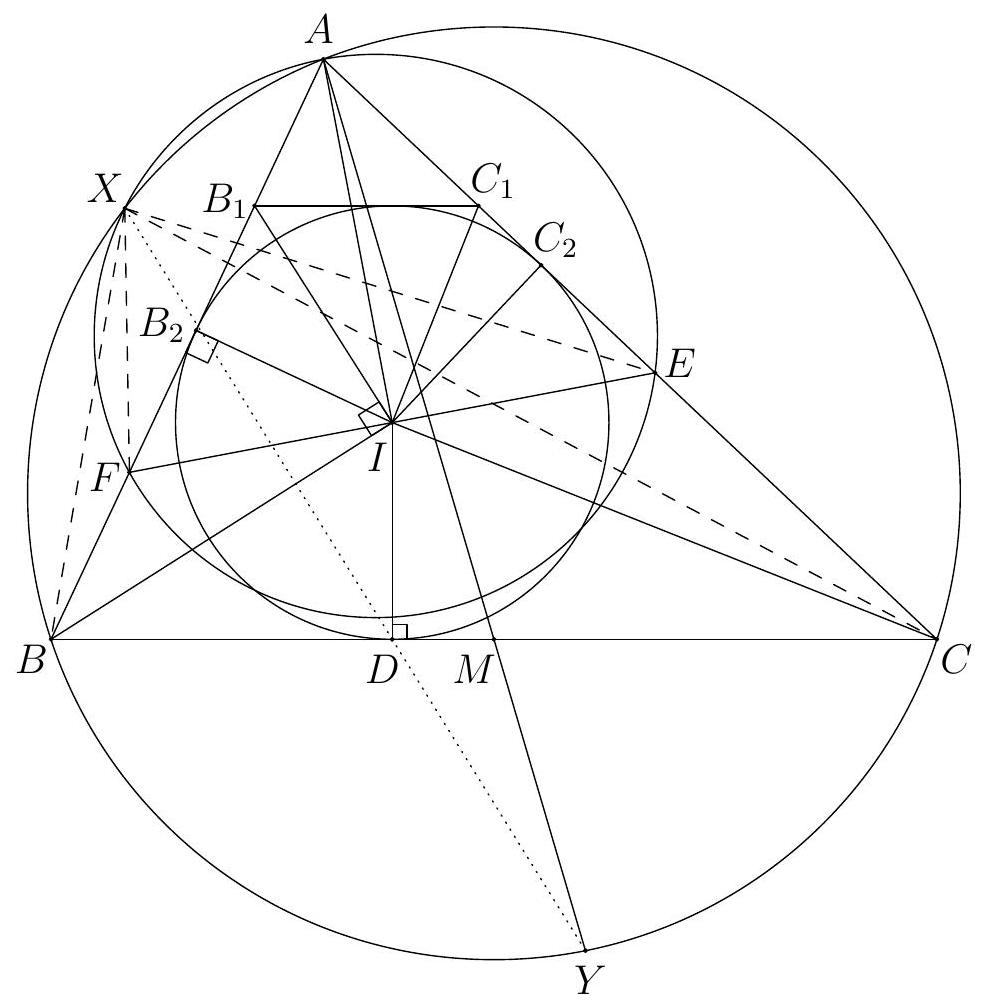
Let meet again at and meet at . It suffices to show . We shall apply the following fact.
- Claim. For any cyclic quadrilateral whose diagonals meet at , we have Proof. We use to denote the area of . Then Applying the Claim to and respectively, we have and . These combine to give Next, we use directed angles to find that and . This shows triangles and are directly similar. In particular, we have In the following, we give two ways to continue the proof.
- Method 1. Here is a geometrical method. As and , the triangles and are similar. Analogously, triangles and are also similar. Hence, we get Next, construct a line parallel to and tangent to the incircle. Suppose it meets sides and at and respectively. Let the incircle touch and at and respectively. By homothety, the line is parallel to the external angle bisector of , and hence . Since , we get , and similarly . Hence, Combining (1), (2), (3) and (4), we conclude so that . The result then follows.
- Method 2. We continue the proof of Solution 1 using trigonometry. Let and . Observe that . Hence, . Similarly, . As , we get This shows and the result follows.
---
Alternative solution.
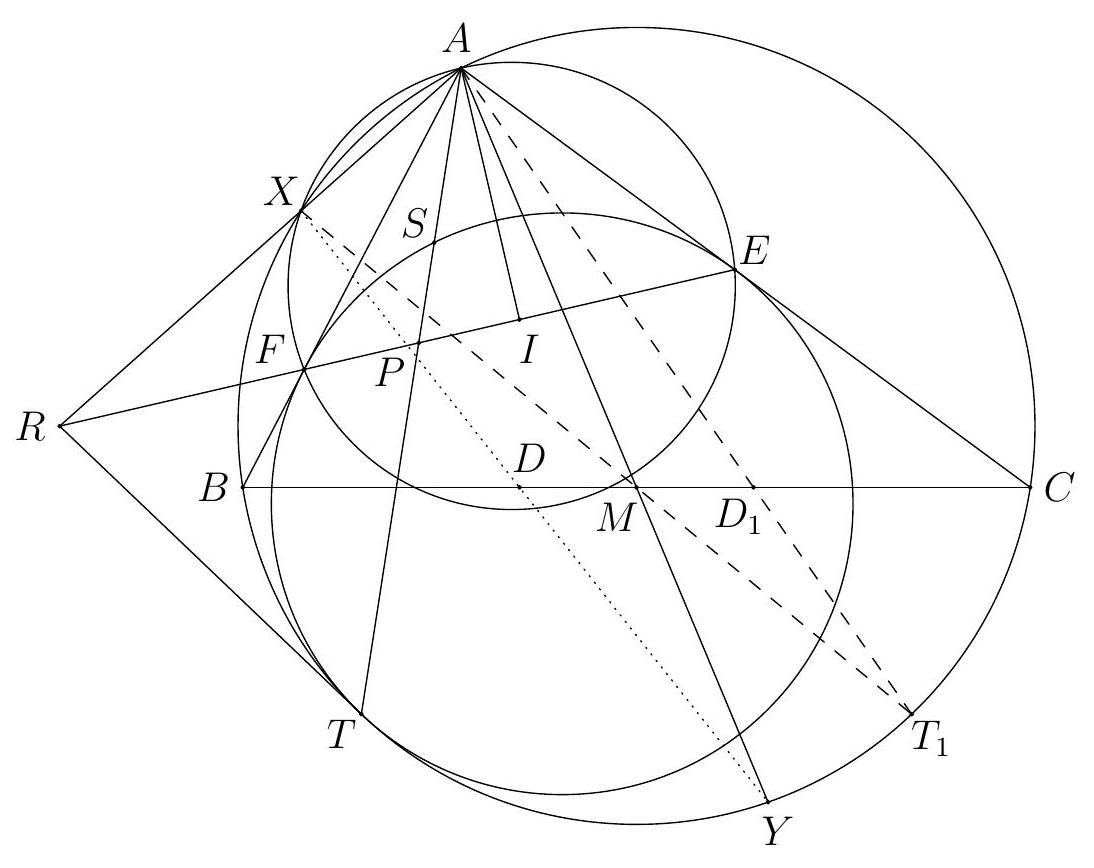
Let be the -mixtilinear incircle of triangle . From the properties of mixtilinear incircles, touches sides and at and respectively. Suppose is tangent to at . Let meet again at , and let be the reflections of and with respect to the perpendicular bisector of respectively. It is well-known that so that are collinear. We then show that are collinear. Let be the radical centre of and the circumcircle of triangle . Then lies on and the tangent at to . Let meet again at and meet at . Obviously, is a harmonic quadrilateral. Projecting from , the pencil () is harmonic. We further project the pencil onto from , so that is a harmonic quadrilateral. As , the projection from onto maps to a point at infinity, and hence maps to the midpoint of , which is . This shows are collinear. We have two ways to finish the proof.
- Method 1. Note that both and are chords of passing through the midpoint of the chord . By the Butterfly Theorem, and cut at a pair of symmetric points with respect to , and hence are collinear. The proof is thus complete.
- Method 2. Here, we finish the proof without using the Butterfly Theorem. As is an isosceles trapezoid, we have so that are concyclic. As are collinear, we have This shows are collinear.
- Claim. For any cyclic quadrilateral whose diagonals meet at , we have Proof. We use to denote the area of . Then Applying the Claim to and respectively, we have and . These combine to give Next, we use directed angles to find that and . This shows triangles and are directly similar. In particular, we have In the following, we give two ways to continue the proof.
- Method 1. Here is a geometrical method. As and , the triangles and are similar. Analogously, triangles and are also similar. Hence, we get Next, construct a line parallel to and tangent to the incircle. Suppose it meets sides and at and respectively. Let the incircle touch and at and respectively. By homothety, the line is parallel to the external angle bisector of , and hence . Since , we get , and similarly . Hence, Combining (1), (2), (3) and (4), we conclude so that . The result then follows.
- Method 2. We continue the proof of Solution 1 using trigonometry. Let and . Observe that . Hence, . Similarly, . As , we get This shows and the result follows.
---
Alternative solution.
Let be the -mixtilinear incircle of triangle . From the properties of mixtilinear incircles, touches sides and at and respectively. Suppose is tangent to at . Let meet again at , and let be the reflections of and with respect to the perpendicular bisector of respectively. It is well-known that so that are collinear. We then show that are collinear. Let be the radical centre of and the circumcircle of triangle . Then lies on and the tangent at to . Let meet again at and meet at . Obviously, is a harmonic quadrilateral. Projecting from , the pencil () is harmonic. We further project the pencil onto from , so that is a harmonic quadrilateral. As , the projection from onto maps to a point at infinity, and hence maps to the midpoint of , which is . This shows are collinear. We have two ways to finish the proof.
- Method 1. Note that both and are chords of passing through the midpoint of the chord . By the Butterfly Theorem, and cut at a pair of symmetric points with respect to , and hence are collinear. The proof is thus complete.
- Method 2. Here, we finish the proof without using the Butterfly Theorem. As is an isosceles trapezoid, we have so that are concyclic. As are collinear, we have This shows are collinear.
Techniques
Cyclic quadrilateralsTangentsRadical axis theoremHomothetyPolar triangles, harmonic conjugatesTrigonometryAngle chasingTriangle centers: centroid, incenter, circumcenter, orthocenter, Euler line, nine-point circle