Browse · MathNet
PrintXXVII Olimpiada Matemática Rioplatense
Argentina geometry
Problem
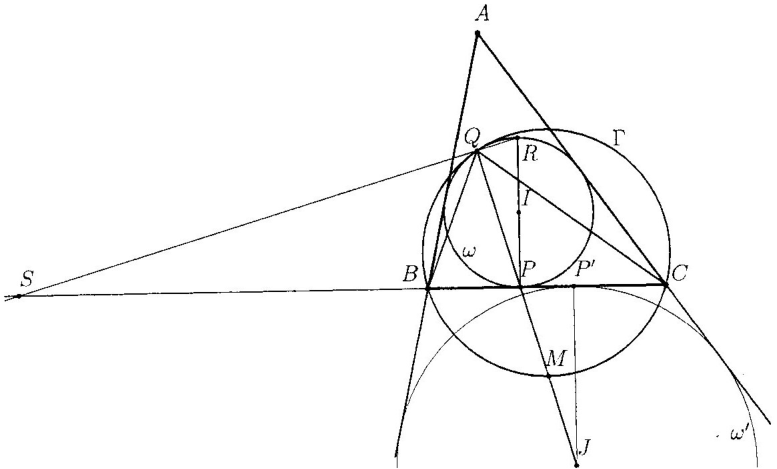
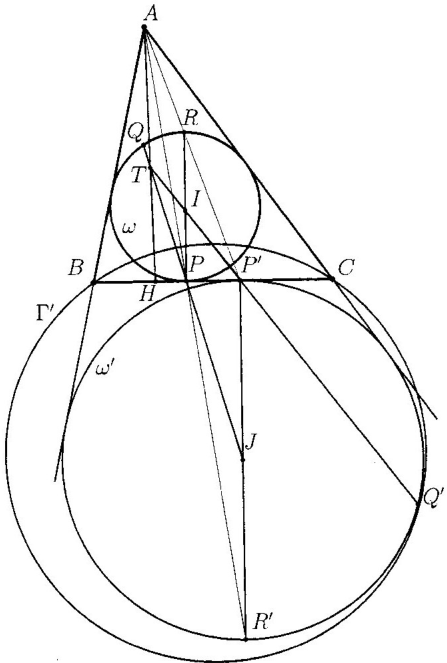
Let be an acute-angled and scalene triangle, its incircle and the excircle relative to the vertex . The circles and are tangent to at and respectively. Let be the circumference passing through and that is tangent to in a point , and be the circumference passing through and that is tangent to in a point . The lines and intersect in . Prove that is perpendicular to .
Solution
Let be the intersection of the lines and .
First, note that the homothety with center which transforms into maps to a point in whose tangent is parallel to , namely, . Then, , , are collinear. Then, the equality implies that is the internal bisector of and, since , it follows that is the external bisector of .
Setting , , , and , we have that , and (in case ; the other case is similar), and, by the angle bisector theorem, we have: Then, or, equivalently, .
Let be the area, the inradius, and the -exradius of the triangle . We have that ; hence, . Therefore, , which implies that: and, as a consequence, (here, we use that ).
Therefore, is the center of the excircle of relative to the vertex .
Similarly, it can be proved that passes through the incenter of . (To do this, it suffices to show that is the internal bisector of and that, if is the point diametrically opposite to in , then is the external bisector of . Then, if is the intersection point of and we can show as before that ).
Now we will prove that both lines and pass through the midpoint of the altitude of the triangle . This finishes the problem, since would be the intersection of the lines and , and is perpendicular to . The homothety with center that transforms into , transforms the diameter into the diameter . Since (since ), and , are medians relative to the corresponding parallel sides and , then , and are collinear. In addition, since (because ) and , are medians relative to the corresponding parallel sides and , then , , are also collinear. Therefore, and both pass through , as we wanted to prove.
First, note that the homothety with center which transforms into maps to a point in whose tangent is parallel to , namely, . Then, , , are collinear. Then, the equality implies that is the internal bisector of and, since , it follows that is the external bisector of .
Setting , , , and , we have that , and (in case ; the other case is similar), and, by the angle bisector theorem, we have: Then, or, equivalently, .
Let be the area, the inradius, and the -exradius of the triangle . We have that ; hence, . Therefore, , which implies that: and, as a consequence, (here, we use that ).
Therefore, is the center of the excircle of relative to the vertex .
Similarly, it can be proved that passes through the incenter of . (To do this, it suffices to show that is the internal bisector of and that, if is the point diametrically opposite to in , then is the external bisector of . Then, if is the intersection point of and we can show as before that ).
Now we will prove that both lines and pass through the midpoint of the altitude of the triangle . This finishes the problem, since would be the intersection of the lines and , and is perpendicular to . The homothety with center that transforms into , transforms the diameter into the diameter . Since (since ), and , are medians relative to the corresponding parallel sides and , then , and are collinear. In addition, since (because ) and , are medians relative to the corresponding parallel sides and , then , , are also collinear. Therefore, and both pass through , as we wanted to prove.
Techniques
TangentsHomothetyTriangle centers: centroid, incenter, circumcenter, orthocenter, Euler line, nine-point circleAngle chasing