Browse · MathNet
PrintJapan Junior Mathematical Olympiad
Japan geometry
Problem
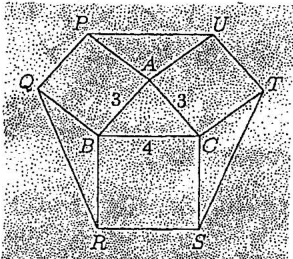
In the exterior of a triangle , 3 squares , and , each having a side of the triangle as one of its sides, were drawn. If , and , determine the area of the hexagon . Here we denote for a line segment its length also by .
Solution
First, let us show that the areas of the triangles , and are all equal to the area of the triangle . Since we have , and , if we rotate the triangle clockwise for around the axis through , it lands onto a triangle having the length of the base and the height equal to those of the triangle . Therefore, the triangle has the same area as that of the triangle . The same argument shows that the triangles and also have the same area as .
Therefore, the area of the hexagon equals the sum of the areas of the 3 squares , , plus 4 times the area of the triangle . The sum of the areas of the 3 squares is .
It remains to compute the area of the triangle . Since it is an isosceles triangle with , the line segment connecting the vertex to the midpoint of the base satisfies . By the Pythagorean theorem, we get . Therefore, the area of the triangle is and we conclude that the area of the hexagon is .
Therefore, the area of the hexagon equals the sum of the areas of the 3 squares , , plus 4 times the area of the triangle . The sum of the areas of the 3 squares is .
It remains to compute the area of the triangle . Since it is an isosceles triangle with , the line segment connecting the vertex to the midpoint of the base satisfies . By the Pythagorean theorem, we get . Therefore, the area of the triangle is and we conclude that the area of the hexagon is .
Final answer
34 + 8√5
Techniques
RotationTriangle trigonometryAngle chasing